Tension and purchase: the physics of a tight line
Why a trucker's hitch multiplies your pull, where friction steals some of it back, why guy-line angles matter, why a line can never be pulled perfectly straight, and why taut cords sing in the wind. A little real physics, worked through with numbers.
Tension is a force along the line
Tension is the pulling force carried along a rope. In a light rope with no friction, the tension is the same everywhere along it, which is the starting point for every calculation below. Force is measured in newtons (N); a mass of 1 kg weighs about 9.8 N, so 100 N is roughly the pull of a 10 kg weight.
Rope can only pull. It cannot push, and it can only pull along its own length. That simple fact explains most of what follows: angles decide how a line's pull is split into useful and wasted directions.
Mechanical advantage
A purchase (sailors' word for a pulley system or tackle) trades distance for force. In an ideal system with no friction, the mechanical advantage equals the number of rope segments supporting the moving part. Pull 3 m of rope through a 3:1 system and the load moves 1 m, but with one third of the force.
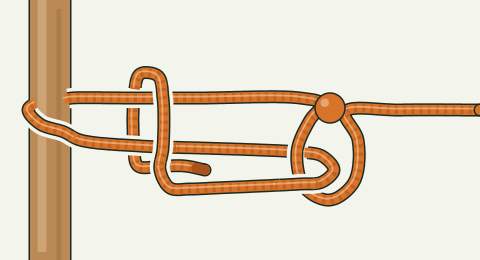
The trucker's hitch is a rope-only purchase. A loop tied in the standing part acts as a pulley. The working end goes around the anchor (a hook, rail or stake), back up through the loop and is pulled. Counting segments gives a theoretical mechanical advantage of 3:1.
Other rope-only purchases work on the same principle. The versatackle passes the line back and forth between two loops to build a larger ratio, and the Spanish windlass uses a stick as a lever to twist a doubled line tight.
Friction: the hidden tax, and the hidden helper
Real systems lose some of their advantage to friction wherever the rope bends around something. The capstan equation describes how friction grows as rope wraps around a round object: T_load = T_hold × e^(μφ), where μ is the coefficient of friction and φ is the wrap angle in radians.
The effect grows exponentially with the wrap. With an illustrative μ of 0.3, one full turn (φ = 2π) gives e^(1.88), a ratio of about 6.6. Two full turns give about 43. This is why a round turn on a post lets you hold a heavy load with one hand, and why a sailor's turns on a winch or cleat work.
In a trucker's hitch the rope runs over rope in the loop, not over a free-turning sheave, so a good share of the theoretical 3:1 is lost to friction. The actual figure depends heavily on rope, diameter and angle. Replace the loop with a ring, carabiner or small pulley and you recover much of it.
Friction is not all loss. It is what lets a trucker's hitch hold while you pinch the line and tie it off, and it is what lets a friction hitch such as the midshipman's hitch grip a guy line. Values of μ for rope vary widely with fibre, finish, wet or dry, so treat the numbers here as illustrations.
Guy lines: why angle matters
A guy line holds a pole or tent edge against a sideways force, such as the pull of a tarp or the push of wind. Call that horizontal force H and the guy line's angle above the ground α. Only the horizontal part of the guy's tension resists H, so the tension needed is T = H ÷ cos α. The vertical part, H × tan α, presses down on the pole and pulls up on the stake.
Worked numbers: at 30 degrees above the ground the guy carries 1.15 H and adds 0.58 H of downward push on the pole. At 45 degrees it carries 1.41 H and adds 1.0 H. At 60 degrees it carries 2.0 H and adds 1.73 H. Steep guy lines are compact but load the cord, the stake and the pole much harder.
The same physics shows up in lifting slings. Rigging guidance warns that as the angle between sling legs widens, the force in each leg climbs quickly, and recommends never exceeding a 120 degree included angle.
Why you cannot pull a line perfectly straight
Hang a weight W from the middle of a line stretched between two points. If each half of the line dips at an angle θ below horizontal, the tension in the line is T = W ÷ (2 × sin θ).
As the line gets flatter, sin θ gets small and the tension climbs fast. At a 10 degree dip the tension is about 2.9 times the weight. At 5 degrees it is about 5.7 times. At 2 degrees it is about 14 times. A perfectly straight line would need infinite tension, which is why every loaded line sags a little.
For a shelter web this is the most important number to understand. A small load hung from the middle of a very tight line puts a large load on the anchors. Allow a little sag, or carry loads close to the supports.
Catenary sag: a line's own weight
Even with nothing hanging on it, a line sags under its own weight. A perfectly flexible line hanging freely takes the shape of a curve called a catenary. For a tight line with small sag, a simpler formula is accurate enough: sag ≈ w × L² ÷ (8 × H), where w is the line's weight per metre, L is the span and H is the horizontal tension.
Worked example: a 10 m span of cord weighing 15 g per metre (w ≈ 0.15 N/m). At 200 N of tension the sag is about 9 mm. At 50 N it is about 37 mm. Halve the sag and you double the tension. This is why a long ridgeline can never be made dead flat, and why trying too hard only loads the anchors.
Why taut lines sing
When wind blows across a cord, it sheds small swirls of air (vortices) alternately from each side. Each swirl gives the cord a tiny sideways push. The frequency of this shedding follows a simple rule: f ≈ St × V ÷ d, where V is wind speed, d is the cord diameter and St, the Strouhal number, is about 0.2 for a round cylinder over a wide range of conditions.
Worked example: a 3 mm cord in a 10 m/s breeze sheds vortices at about 0.2 × 10 ÷ 0.003 ≈ 670 times a second, a clearly audible tone. Halve the wind and the pitch drops by half.
A tight line also has its own natural frequencies, like a guitar string: f_n = (n ÷ 2L) × √(T ÷ μ), where L is length, T is tension, μ is mass per metre and n is 1, 2, 3 and so on. When the shedding frequency lands near one of these, the line locks in and vibrates strongly. That is the hum or moan you hear from guy lines, wire fences and the strings of an Aeolian harp.
Because frequency rises with the square root of tension, doubling the tension raises the pitch by about half an octave. Singing is harmless on a tent line in a breeze, but sustained vibration fatigues materials. Power lines carry Stockbridge dampers, small weights on a short cable, to absorb exactly this kind of wind-driven vibration.
What this means in practice
None of this is new. Riggers on sailing ships, tentmakers and bridge builders worked with these effects for centuries. The formulas just put numbers on what good hands already knew.
- A trucker's hitch is worth about 3:1 in theory and noticeably less in use; a ring or pulley in the loop helps.
- A round turn on a post or rail gives you a lot of holding friction for free.
- Lower guy-line angles load cord, stakes and poles less, at the cost of a larger footprint.
- Never try to pull a loaded line perfectly flat: the anchor loads climb steeply as the sag disappears.
- Low-stretch cord such as polyester holds tension better than stretchy nylon in a web that must stay tight.
- A singing line is a tight line. If it hums constantly in steady wind, check for chafe where it touches anything.
Knots in this guide
Tensioners
Trucker's hitch
A simple pulley system built into the rope itself, giving a theoretical 3:1 purchase for tensioning loads, tarps and ridgelines.
Tensioners
Versatackle
A rope-only purchase made by running the line back and forth between two loops, which grips itself under tension.
Tensioners
Spanish windlass
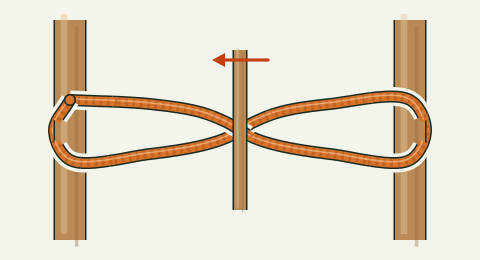
A loop of rope twisted with a stick to pull two points together with great force.
Tensioners
Deadeye and lanyard
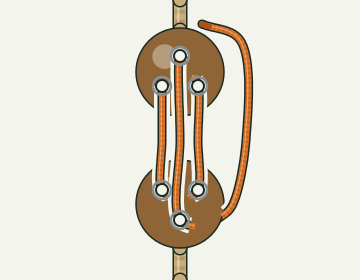
A pair of holed wooden discs laced together with a lanyard, used to set up and tension a ship's shrouds.
Hitches
Round turn and two half hitches
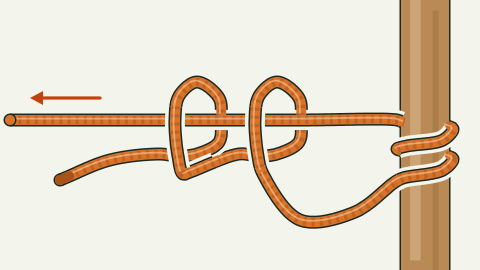
A full round turn around a post or ring, finished with two half hitches on the standing part: the dependable everyday way to tie a line off.
Friction hitches
Midshipman's hitch
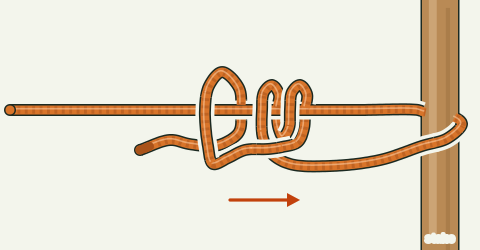
An adjustable loop made by tying Ashley's rolling hitch version 2 around the standing part; its tucked second turn grips before the knot is finished and holds better than the common taut-line hitch.
Friction hitches
Taut-line hitch
An adjustable loop made by tying a rolling hitch (Ashley's version 1) back around the standing part, so the knot can be slid to tension a guy line.
Friction hitches
Adjustable grip hitch
A modern slide-and-grip hitch for tensioning a guy line or ridgeline: it slides along the standing part when slack and holds when loaded.
Loops
Alpine butterfly
A fixed loop tied in the middle of a rope that can take load from either end of the rope or from the loop itself.
Sources
- Tension (physics), Wikipedia
- Mechanical advantage, Wikipedia
- Block and tackle, Wikipedia
- Trucker's hitch, Wikipedia
- Versatackle knot, Wikipedia
- Spanish windlass, Wikipedia
- Capstan equation, Wikipedia
- Guy-wire, Wikipedia
- NSW Government, Dogging and Rigging Guide: Selection and use of slings
- Catenary, Wikipedia
- Vortex shedding, Wikipedia
- Strouhal number, Wikipedia
- String vibration, Wikipedia
- Mersenne's laws, Wikipedia
- Aeolian harp, Wikipedia
- Stockbridge damper, Wikipedia