The library
Knots, hitches, lashings & splices
67 techniques, each with how to tie it, how it fails, where it came from and where it works today. 33 have step-by-step diagrams so far, with more on the way.
Stoppers
Knots that make a lump in a line so it cannot pull through.
Stoppers
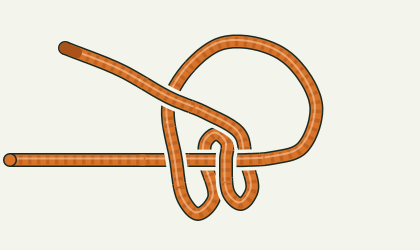
Double overhand stopper
An overhand knot with one extra wrap, giving a fatter, firmer stopper that is hard to pull through anything.
Stoppers
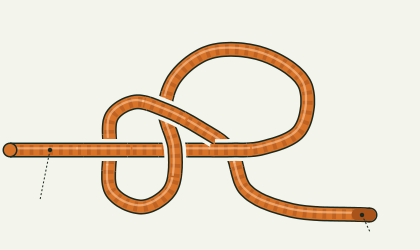
Figure-eight knot
A bulky, easy-to-check stopper that keeps a rope end from running out through a block, cleat, eyelet or device.
Stoppers
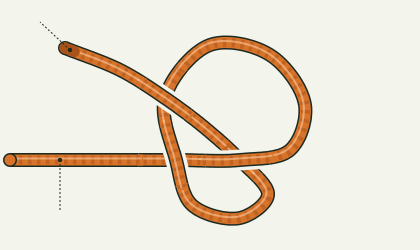
Overhand knot
The simplest knot there is: one loop with the end tucked through, used as a quick stopper and as the starting point for dozens of other knots.
Stoppers
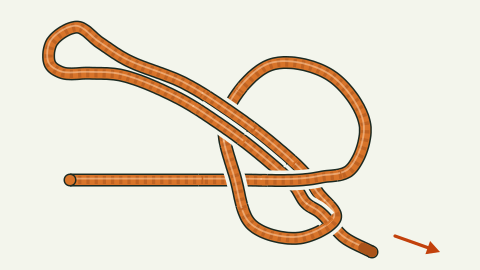
Slip knot
An overhand knot finished with a bight instead of the end, so one pull on the tail releases it instantly.
Loops
Fixed eyes, in the end or the middle of a line.
Loops
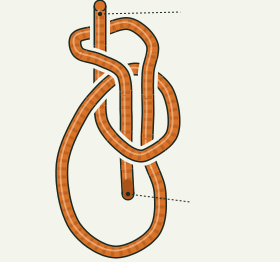
Bowline
A fixed loop in the end of a rope that holds well under steady load and still unties easily afterwards.
Loops
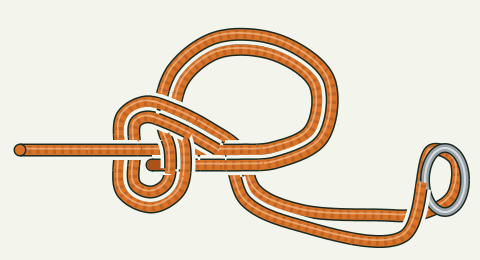
Figure-eight follow-through
A figure-eight loop tied around a closed point, such as a harness or ring, by tying a figure-eight and then retracing it with the end.
Loops
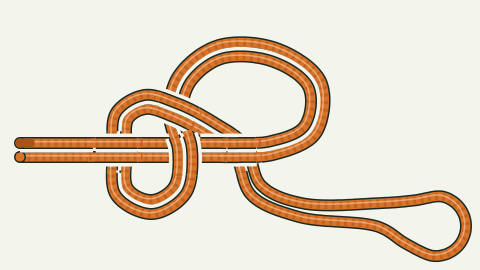
Figure-eight loop
A figure-eight tied in a doubled rope to make a strong, easy-to-inspect fixed loop for clipping a carabiner or hook.
Loops
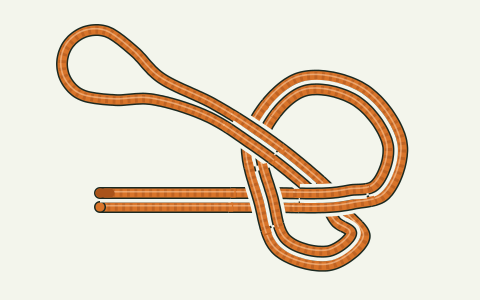
Overhand loop
An overhand knot tied in a doubled rope to make a quick fixed loop anywhere along a line.
Loops
Alpine butterfly
A fixed loop tied in the middle of a rope that can take load from either end of the rope or from the loop itself.
Loops
Bowline on a bight
A bowline tied in a doubled rope to make two fixed loops in the middle of a line, without needing either end.
Loops
Running bowline
A bowline tied around its own standing part to make a strong noose that cinches under load and still unties easily.
Bends
Knots that join two ropes.
Bends
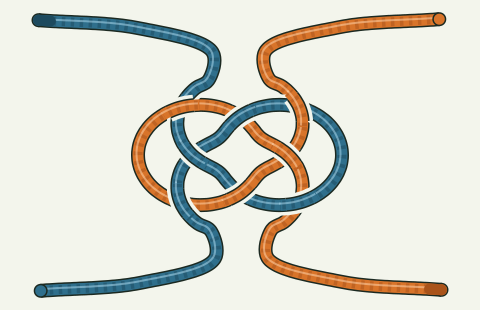
Carrick bend
A woven, symmetrical bend for joining heavy ropes and hawsers that will not jam, even when soaked and heavily loaded.
Bends
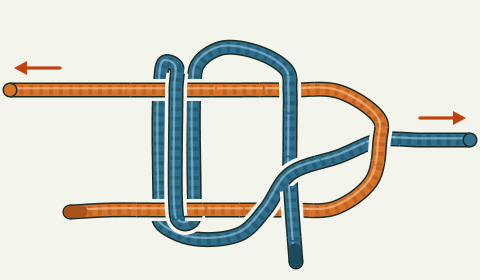
Double sheet bend
A sheet bend with an extra turn, for joining ropes of very different size or slippery line that a single sheet bend would let go.
Bends
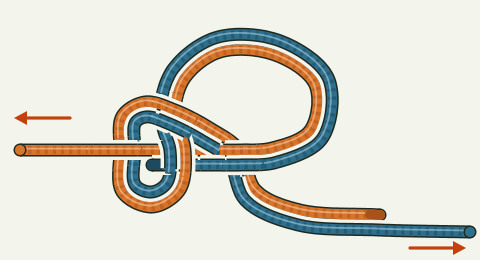
Figure-eight bend
A figure-eight knot retraced by a second rope, making a strong, easy-to-inspect join between two ropes of similar size.
Bends
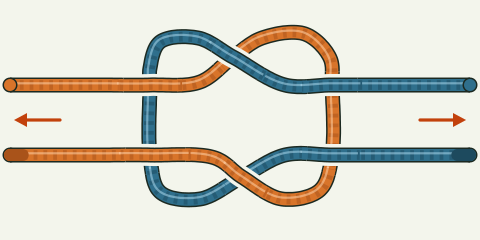
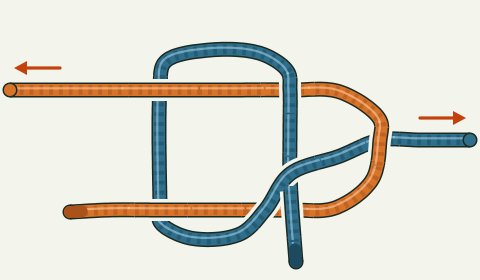
Reef knot
A flat binding knot made of two opposite half knots, for tying the two ends of one cord around a bundle, bandage or sail. It is not a safe way to join two ropes.
Bends
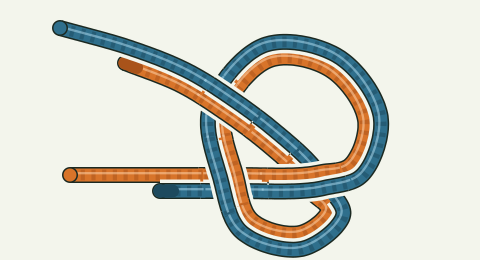
Sheet bend
The everyday knot for joining two ropes, and the best simple bend for ropes of different thickness.
Bends
Water knot
An overhand knot retraced by a second strap, used to join flat webbing into slings and anchors.
Bends
Double fisherman's bend
Two double overhand knots, each tied around the other rope, that slide together into a very strong, near-permanent join.
Bends
Surgeon's knot
A reef knot with a doubled first throw, which grips and holds tension while the second throw is tied.
Bends
Zeppelin bend
A secure, symmetrical join of two interlocked overhand loops that resists jamming and unties easily after heavy load.
Hitches
Knots that tie a rope to something: a post, a ring, a rail.
Hitches
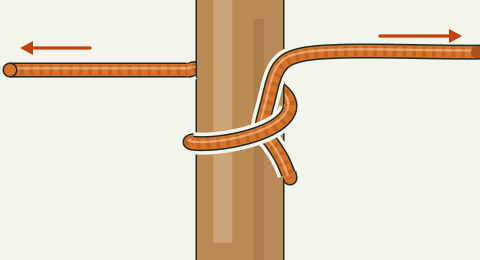
Clove hitch
Two half hitches made in the same direction around a pole, rail or ring: fast to tie and easy to adjust, but not secure on its own.
Hitches
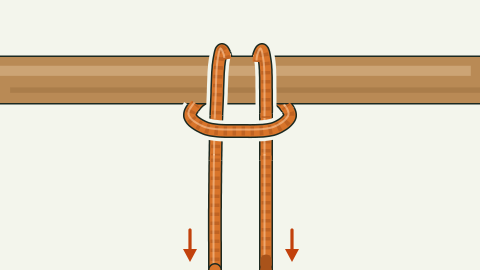
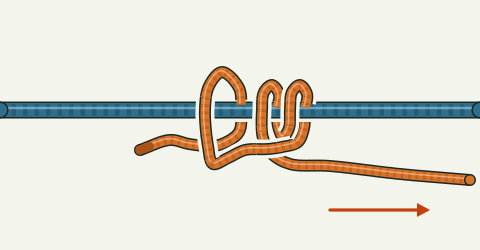
Cow hitch
Two half hitches made in opposite directions around an object; tied with a closed loop it becomes the girth hitch used for slings, tags and lanyards.
Hitches
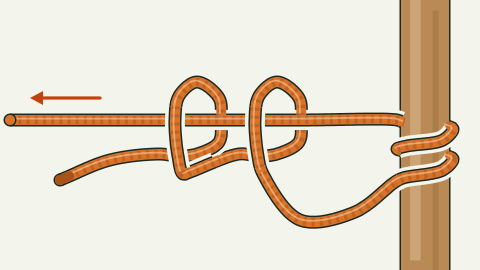
Rolling hitch
A friction hitch that holds a lengthwise pull along a pole, rail or another rope in one chosen direction.
Hitches
Round turn and two half hitches
A full round turn around a post or ring, finished with two half hitches on the standing part: the dependable everyday way to tie a line off.
Hitches
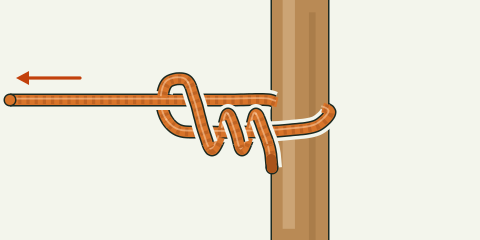
Timber hitch
A noose made by twisting the end around its own part several times: it grips a log or spar while pulled and falls open when the pull stops.
Hitches
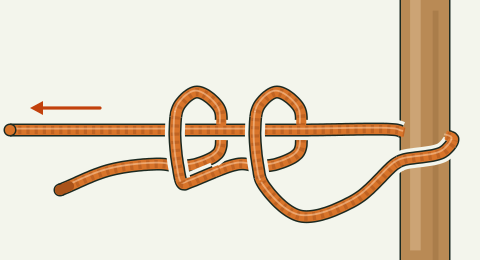
Two half hitches
A single turn around an object finished with two half hitches on the standing part: quick and simple for light to moderate steady loads.
Hitches
Anchor bend
A round turn through a ring with the first half hitch tucked under the turn: a secure, jam-resistant way to tie a rope to an anchor shackle or ring.
Hitches
Buntline hitch
A compact hitch made by tying a clove hitch around the standing part with its turns working toward the object; shaking and flogging tighten it rather than loosen it.
Hitches
Marlinspike hitch
A quick slip-noose trap that holds a spike, stick or toggle crosswise in a rope, to make a handle, a toggle point or a quick attachment.
Hitches
Pile hitch
A hitch tied with a bight and dropped over the top of a post: quick to make in the middle of a line and quick to cast off.
Hitches
Siberian hitch
A quick-release hitch, a slipped figure-eight noose around the standing part, that can be tied and released with gloves on; popular as the first anchor of a tarp ridgeline.
Friction hitches
Grips that slide when loose and hold under load.
Friction hitches
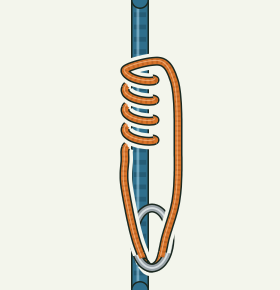
Autoblock
A friction hitch made by spiralling a short cord loop around the rope and clipping both ends into one carabiner; it is the common hands-free backup below an abseil device.
Friction hitches
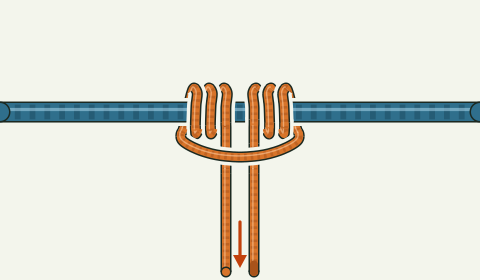
Prusik
A symmetrical friction hitch tied with a loop of thinner cord around a rope: it slides when pushed and grips when its loop is loaded, in either direction.
Friction hitches
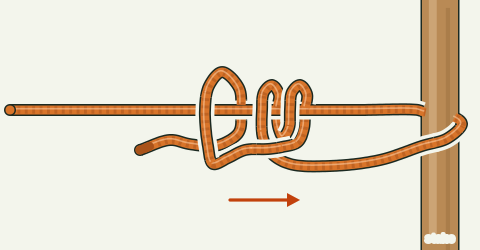
Taut-line hitch
An adjustable loop made by tying a rolling hitch (Ashley's version 1) back around the standing part, so the knot can be slid to tension a guy line.
Friction hitches
Adjustable grip hitch
A modern slide-and-grip hitch for tensioning a guy line or ridgeline: it slides along the standing part when slack and holds when loaded.
Friction hitches
Blake's hitch
A friction hitch tied with the end of a rope around its own standing part, used by arborists as an ascending and descending hitch in closed-system tree climbing.
Friction hitches
Klemheist
A one-direction friction hitch made by spiralling a cord or sling loop around a rope and passing the lower end through the top bight; it grips when pulled down and slides when pushed up.
Friction hitches
Midshipman's hitch
An adjustable loop made by tying Ashley's rolling hitch version 2 around the standing part; its tucked second turn grips before the knot is finished and holds better than the common taut-line hitch.
Binding knots
Knots that squeeze round a bundle or the neck of a bag.
Binding knots
Constrictor knot
A binding knot like a clove hitch with the end tucked to form an overhand knot under a riding turn; it bites down hard and stays put.
Binding knots
Strangle knot
A binding knot made of a round turn with the end tucked under both turns: a rearranged double overhand that grips a bundle or a rope end.
Lashings
Turns and frapping that join poles into frames.
Lashings
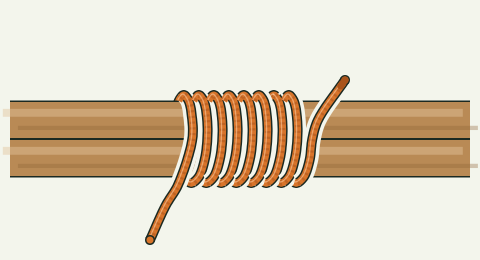
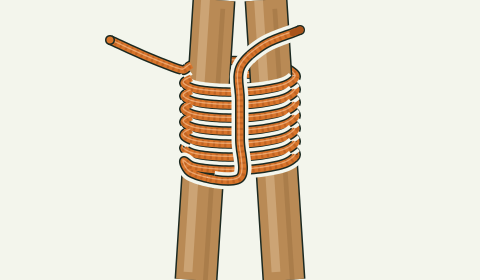
Round lashing
A tight binding that joins two overlapping poles side by side, most often to make a longer pole.
Lashings
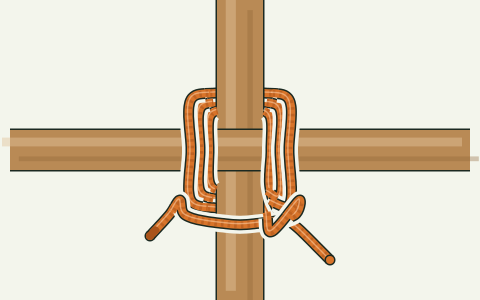
Shear lashing
A hinge-like lashing that binds two parallel poles so they can be opened into an A-frame or shear legs.
Lashings
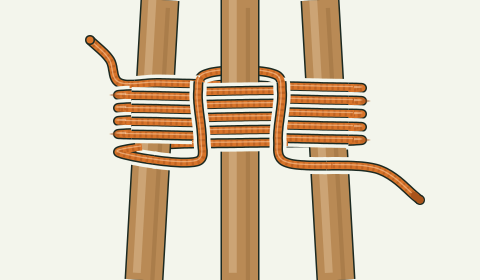
Square lashing
A rope binding that locks two crossing poles together so they cannot slide over each other.
Lashings
Tripod lashing
A lashing that binds three poles at the top so they can be spread into a free-standing tripod.
Lashings
Diagonal lashing
A lashing that pulls together two crossing poles that do not touch, used for X-braces that stop a frame racking.
Tensioners
Purchases and windlasses that pull a line tight.
Tensioners
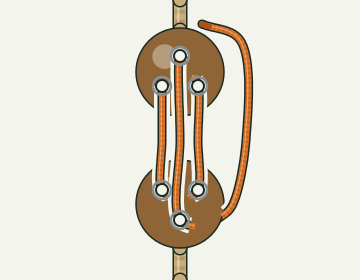
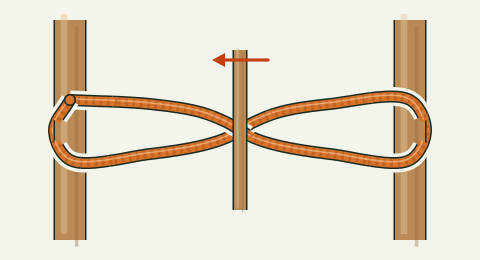
Deadeye and lanyard
A pair of holed wooden discs laced together with a lanyard, used to set up and tension a ship's shrouds.
Tensioners
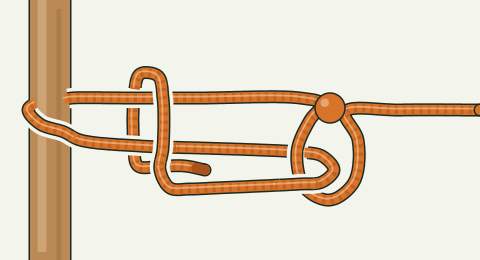
Spanish windlass
A loop of rope twisted with a stick to pull two points together with great force.
Tensioners
Trucker's hitch
A simple pulley system built into the rope itself, giving a theoretical 3:1 purchase for tensioning loads, tarps and ridgelines.
Tensioners
Versatackle
A rope-only purchase made by running the line back and forth between two loops, which grips itself under tension.
Functional & decorative
Buttons, balls, toggles, shackles and grommets.
Functional & decorative
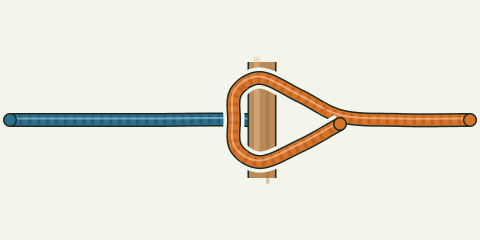
Toggle and becket
A short pin on one part that pushes through a rope loop on the other, giving a strong connection that opens instantly.
Functional & decorative
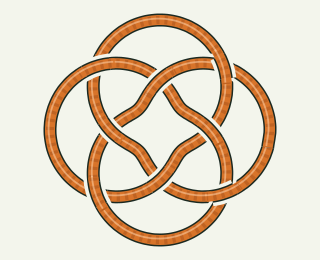
Turk's head
A woven ring of cord tied around a cylinder, used as a collar, grip, marker or ornament.
Functional & decorative
Chain lacing
A way of joining two edges of fabric by passing a loop through each pair of eyelets and through the loop before it, so the seam locks and then unzips in one pull.
Functional & decorative
Chain sinnet
A row of crochet-like loops, each pulled through the last, that shortens and stores a rope and runs out instantly when released.
Functional & decorative
Diamond knot
A firm, round knot tied with both ends of a cord that leaves a loop above it, used as a lanyard knot, a button and the head of a soft shackle.
Functional & decorative
Monkey's fist
A round ball of woven cord tied in the end of a line to give it weight for throwing, or as a knob or ornament.
Functional & decorative
Pebble hitch
A tie point made anywhere in a sheet of fabric by wrapping a smooth stone or ball in the cloth and noosing the neck below it.
Functional & decorative
Reef point
A short cord fixed through a sail or panel, used to tie up the loose cloth when the sail is reduced, usually with a slipped reef knot.
Functional & decorative
Rope grommet
A seamless ring laid up from a single strand of three-strand rope, with no splice and no metal.
Functional & decorative
Soft shackle
A loop of strong synthetic braid that closes around a knot at its own end, used in place of a metal shackle.
Splices & whippings
Permanent eyes, joins and finished ends.
Splices & whippings
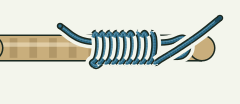
Common whipping
Tight turns of twine wrapped over a loop laid along the rope, with the end drawn back under the turns, to stop a rope end fraying.
Splices & whippings
Back splice
A way of finishing a rope's end by forming a crown knot with its strands and tucking them back down the rope, so it cannot fray.
Splices & whippings
Eye splice
A permanent loop made by weaving the strands of a rope's end back into its own standing part.
Splices & whippings
Locked Brummel eye splice
An eye splice for hollow-braid rope such as Dyneema, in which the tail and standing part pass through each other to lock the eye before the tail is buried.
Splices & whippings
Sailmaker's whipping
A very durable whipping for laid rope in which the twine is also laid along the grooves between the strands, so the turns cannot slide off.
Splices & whippings
Short splice
A strong, permanent join between the ends of two three-strand ropes, made by interlacing their strands and tucking each into the other rope.
Historic
Knots with a story more than a job.
Historic
Jury mast knot
A three-loop knot tied in the middle of a rope and dropped over a spar, traditionally described as a way to rig stays on a makeshift mast.
Historic
Sheepshank
An old shortening knot that takes up slack in the middle of a rope, or bypasses a weak spot, while both ends stay fast.
No knots match that search.