Strength and safety: what the numbers mean
A rope's label strength is not what you can safely hang on it. This guide explains breaking strength, working load limits, safety factors, how much strength a knot costs, why shock loads are dangerous and when to retire a rope.
Read this first
Nothing in this library replaces training. Any use where a person could be hurt if the rope fails (climbing, rescue, rope access, tree work, lifting loads over people) needs certified equipment, the maker's instructions and instruction from a qualified person. The rules of thumb below are for understanding, not for life-safety rigging.
Breaking strength and working load limit
Minimum breaking strength (MBS) is the load at which a new rope of that type is expected to break in a standard laboratory pull test, usually with spliced ends, pulled slowly in a straight line. Some makers quote average breaking strength instead, which is higher. Real use is almost always harsher than the test.
Working load limit (WLL) is the largest load the rope should carry in normal service. It is the breaking strength divided by a design factor (also called a safety factor). In Cordage Institute guidance, design factors for fibre rope commonly run from 5 to 12 depending on the job, and the WLL applies only to new rope with standard terminations.
Example: a cord with a minimum breaking strength of 4 kN (about 400 kg) and a design factor of 10 has a working load limit of 0.4 kN, roughly 40 kg. That gap is not waste. It covers knots, wear, sunlight, sharp edges, wet rope and loads that are bigger than you think.
Safety factors and why they are big
A design factor protects against everything you have not measured. Higher factors are used where loads are dynamic, where the rope is old or knotted, and where failure would hurt someone. Rope guidelines recommend expert advice whenever shock loads are possible or the rope is used for lifting.
Angles multiply loads. In multi-leg slings the force in each leg climbs quickly as the angle between the legs widens; Australian rigging guidance says not to use slings with an included angle over 120 degrees. The same physics applies to a cord pulled tight between two points, which is covered in the tension and purchase guide.
What a knot costs: knot efficiency
Any knot bends the rope tightly, so the fibres on the outside of the bend take more than their share of the load. The knotted rope breaks at the knot, below the strength of a straight rope. The ratio is called knot efficiency or relative knot strength.
Published tests commonly put common knots at roughly 40 to 80 per cent of the unknotted rope's strength. Results vary a lot with rope material, construction, diameter, wet or dry rope, how the knot was dressed and how fast it was pulled. A knot that tests well in one rope can test poorly in another, so treat any single figure as a guide only.
Splices generally keep more strength than knots, which is one reason permanent eyes on working lines are spliced.
Practical rule: assume a knotted line is significantly weaker than its label, and build that into your design factor.
Shock loading
A load that drops, jerks or snaps tight produces a peak force far higher than its weight. The energy has to go somewhere, and a stiff, low-stretch rope (polyester, HMPE, wire) stops it over a short distance, which means a high force. A stretchy rope (nylon) stops it over a longer distance and the peak force is lower.
This is why climbers use dynamic nylon ropes, and why a static rope or a sling of HMPE should never be used where a person could fall onto it. For a shelter, it is also why a gust slamming into a slack line is harder on everything than a steady wind on a taut one.
Life-safety versus utility
Utility rope (hardware-store cord, tent guy lines, tie-downs) is not tested or certified for holding people. Life-safety rope is made and tested to a standard (for example the EN or UIAA standards for climbing ropes), sold with instructions and traceable to a batch. Never use utility rope, or knots you have learned only from a book or screen, to support a person.
Knots that are fine for utility but unsafe or unreliable under critical load include the reef knot used as a bend, the sheepshank, the single overhand bend, and friction hitches that have not been tested on the exact rope pair.
Inspection
Look and feel along the whole length before important use. Run it through your hands slowly.
- Cuts, worn or furry patches, and glazed or melted spots.
- Core damage in sheathed rope: flat spots, lumps, soft or hollow sections, or core showing through the sheath.
- Stiff or crunchy sections, discolouration, or a powdery feel (common signs of UV or chemical damage).
- Contact with acids, battery fluid, solvents or unknown chemicals.
- In laid rope: open the lay a little and look inside for broken yarns, powder or rot.
- In HMPE: check splices and any section that has run over a hot surface or sharp edge.
When to retire a rope
Retire a rope when inspection finds damage, after a severe shock load, after contact with chemicals, or when the maker's age limit is reached. Climbing gear makers give guidance that ranges from about a year for daily heavy use to several years for occasional use, with a maximum shelf life even if unused. When in doubt, cut it up and give it a second life as utility cord, never as a life-safety line.
Knots in this guide
Bends
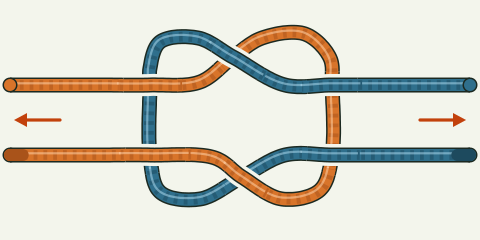
Reef knot
A flat binding knot made of two opposite half knots, for tying the two ends of one cord around a bundle, bandage or sail. It is not a safe way to join two ropes.
Historic
Sheepshank
An old shortening knot that takes up slack in the middle of a rope, or bypasses a weak spot, while both ends stay fast.
Loops
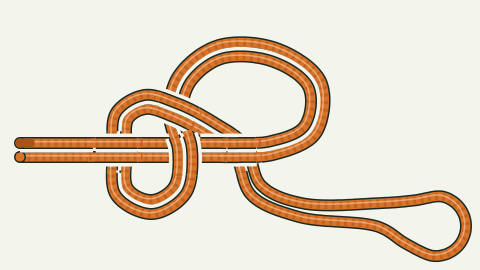
Figure-eight loop
A figure-eight tied in a doubled rope to make a strong, easy-to-inspect fixed loop for clipping a carabiner or hook.
Loops
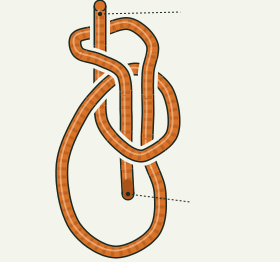
Bowline
A fixed loop in the end of a rope that holds well under steady load and still unties easily afterwards.
Splices & whippings
Eye splice
A permanent loop made by weaving the strands of a rope's end back into its own standing part.
Bends
Double fisherman's bend
Two double overhand knots, each tied around the other rope, that slide together into a very strong, near-permanent join.
Friction hitches
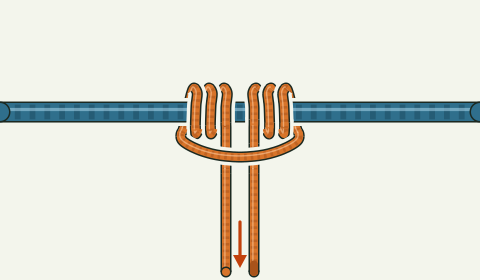
Prusik
A symmetrical friction hitch tied with a loop of thinner cord around a rope: it slides when pushed and grips when its loop is loaded, in either direction.
Tensioners
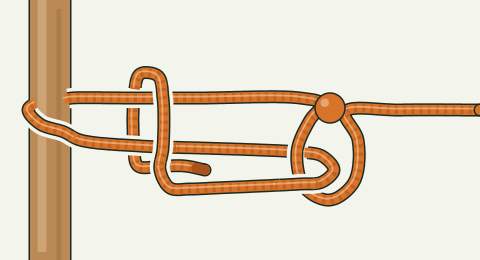
Trucker's hitch
A simple pulley system built into the rope itself, giving a theoretical 3:1 purchase for tensioning loads, tarps and ridgelines.
Sources
- Ravenox: Recommended safety practices for use of fibre rope (summarising Cordage Institute guidance)
- Samson Rope: Warning statement
- Working load limit, Wikipedia
- Factor of safety, Wikipedia
- NSW Government, Dogging and Rigging Guide: Selection and use of slings
- Knot (efficiency of common knots 40 to 80 per cent), Wikipedia
- Šimon, Dekýš and Palček (2020), Revision of commonly used loop knots efficiencies, Acta Physica Polonica A
- University of Strathclyde: An assessment of the strength of knots and splices used as eye terminations in a sailing environment
- CMC: Evaluating knot efficiency in 11 mm ropes
- Dynamic rope, Wikipedia
- Shock (mechanics), Wikipedia
- Petzl: How do I wash a rope? (inspection and retirement notes)
- REI: When to retire climbing gear
- Reef knot, Wikipedia
- Sheepshank, Wikipedia