Rope materials: natural and synthetic fibres
What a rope is made of decides how it stretches, floats, ages in the sun, copes with heat and holds a knot. This guide compares the common natural and synthetic fibres and where each one earns its place.
Why fibre matters
Two ropes of the same diameter can differ several times over in strength, stretch and life outdoors. Fibre also changes how knots behave: slippery, low-stretch fibres such as HMPE hold some knots poorly, while stretchy nylon grips and sets well.
Figures below are typical values from manufacturers' engineering data and rigging guides. They vary between products, so always check the data sheet for the rope you are buying before you rely on a number.
Natural fibres
Manila: made from abacá, a banana relative grown mainly in the Philippines. It was the standard quality ship's rope before synthetics and is the strongest of the common natural rope fibres. It handles well and grips knots, but it rots if stored wet and has a fraction of the strength of a synthetic rope the same size.
Sisal: from the leaves of an agave. Cheaper, harsher and weaker than manila. Used for baler twine, cat scratching posts, garden ties and general utility.
Hemp: a bast fibre from the stem of the cannabis plant. For centuries it was the main rope fibre of European navies, made on long ropewalks and tarred against rot. Today it is used for traditional rigging, craft and decoration.
Cotton: soft, flexible and kind to hands, but weak and prone to rot. Used for sash cord, macramé, decorative ropework, bell ropes and theatre lines where feel matters more than strength.
Coir: coconut husk fibre. Coarse, stretchy, relatively weak, but it floats and resists salt water well. Used for mats, erosion-control netting and traditional cordage across South and South East Asia and the Pacific, where coconut sennit lashed canoes and houses.
Lime bast and other tree barks: the inner bark of lime (linden) trees was a main rope material in Viking-age Scandinavia. The Viking Ship Museum in Roskilde still hand-makes lime bast rope for its reconstructed ships.
Synthetic fibres
Nylon (polyamide): strong and the stretchiest of the common rope fibres, so it absorbs shock well. That is why dynamic climbing ropes, anchor rodes, dock lines and tow straps use it. It loses some strength when wet, and its stretch makes it a poor choice where you want a line to stay tight. Melting point roughly 215 to 260 degrees C depending on type (nylon 6 or nylon 6,6). Sinks in water.
Polyester (PET): nearly as strong as nylon with much less stretch, little change when wet, and good resistance to sunlight and abrasion. The all-round choice for sailing sheets and halyards, guy lines and utility cord. Melting point about 255 degrees C. Sinks. Polyester rope is also used in deepwater mooring lines for offshore platforms, a use pioneered by Petrobras in the mid 1990s.
Polypropylene: cheap, light and the only common synthetic that floats while costing little. It is used for water-ski tow ropes, rescue throw lines, marker lines and cheap utility rope. It has poor resistance to sunlight unless stabilised, wears quickly, and melts at only about 165 degrees C, so it can glaze or fail from friction heat.
UHMWPE, also called HMPE (brands include Dyneema and Spectra): extremely strong for its weight and very low stretch. It floats, resists UV well and is slippery, so some knots slip in it and splices are preferred. It creeps (slowly lengthens) under sustained load, and it melts at only about 145 to 150 degrees C, so it can be damaged by friction heat from a fast-running line. Used for soft shackles, yacht rigging, winch lines on four-wheel drives, arborist slings and high-end pack and tent cord.
Aramid (brands include Kevlar, Technora, Twaron): very strong, very low stretch and does not melt; it chars and breaks down at high temperature, which makes it useful where heat is a risk. It is sensitive to UV and to repeated sharp bending, so it is often used as a core inside a protective cover. Used for fire-rescue cord, heat-resistant sheaths and some racing lines.
Liquid crystal polymer (Vectran): very strong, low creep. NASA's BEAM expandable module on the International Space Station is built from layers of soft goods, including Vectran, around a metal frame, with a woven restraint layer carrying the main structural load.
Quick comparison
Stretch, most to least: nylon, polyester and polypropylene, then aramid and HMPE.
Floats: polypropylene, HMPE and coir. Sinks: nylon, polyester, aramid, manila, sisal, hemp and cotton.
Sunlight (UV) resistance, best to worst among the common synthetics: polyester and HMPE are good, nylon is fair, untreated polypropylene and aramid are poor.
Approximate melting points: polypropylene 165 degrees C, HMPE 145 to 150 degrees C, nylon 215 to 260 degrees C, polyester 255 degrees C, aramid does not melt.
Cost, cheapest to dearest: polypropylene and sisal, then manila and nylon and polyester, then HMPE and aramid.
- Shock absorption (anchor rodes, dynamic climbing ropes): nylon.
- Stays tight outdoors (guy lines, ridgelines, sheets): polyester.
- Floats and is cheap (throw lines, ski ropes): polypropylene.
- Maximum strength for weight, low stretch (soft shackles, winch lines): HMPE.
- Heat risk: aramid, usually as a core with a protective cover.
- Feel, craft and tradition: cotton, manila, hemp.
Wear, sunlight, water and heat
Abrasion is the most common way a working rope dies. A rope rubbing over a rock edge, a tent frame or a car roof rack loses strength fast, whatever the fibre. Sleeves and chafe guards are cheap insurance.
Sunlight slowly breaks down most synthetics. Cover is the best protection: a braided sheath shields the core, and rope stored out of the sun lasts much longer.
Heat from friction can melt or glaze a synthetic rope, especially polypropylene and HMPE. Avoid running one synthetic rope fast over another under load, and never let a moving line saw across a stationary one.
Chemicals matter too. Acids, battery fluid and some solvents can damage nylon without obvious signs. Rope with suspected chemical contact should be retired from any important use.
What Strekka uses
For a tension web that stays out in the sun and must stay tight, polyester is the default: low stretch, good UV resistance, and it holds familiar knots well. HMPE suits soft shackles and spliced high-load lines where low weight matters. Natural fibre cord can work in the same system, with the caveat that it loses strength faster outdoors, stretches and shrinks as it wets and dries, and must be dried before storage.
Knots in this guide
Splices & whippings
Eye splice
A permanent loop made by weaving the strands of a rope's end back into its own standing part.
Splices & whippings
Locked Brummel eye splice
An eye splice for hollow-braid rope such as Dyneema, in which the tail and standing part pass through each other to lock the eye before the tail is buried.
Functional & decorative
Soft shackle
A loop of strong synthetic braid that closes around a knot at its own end, used in place of a metal shackle.
Friction hitches
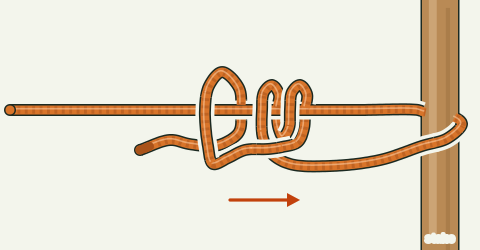
Midshipman's hitch
An adjustable loop made by tying Ashley's rolling hitch version 2 around the standing part; its tucked second turn grips before the knot is finished and holds better than the common taut-line hitch.
Friction hitches
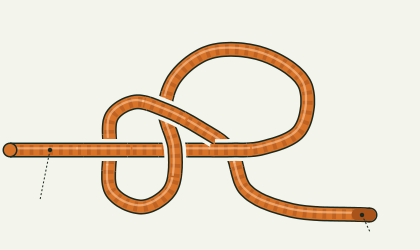
Taut-line hitch
An adjustable loop made by tying a rolling hitch (Ashley's version 1) back around the standing part, so the knot can be slid to tension a guy line.
Stoppers
Figure-eight knot
A bulky, easy-to-check stopper that keeps a rope end from running out through a block, cleat, eyelet or device.
Bends
Double fisherman's bend
Two double overhand knots, each tied around the other rope, that slide together into a very strong, near-permanent join.
Splices & whippings
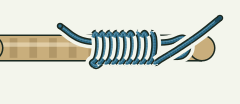
Common whipping
Tight turns of twine wrapped over a loop laid along the rope, with the end drawn back under the turns, to stop a rope end fraying.
Sources
- NSW Government, Dogging and Rigging Guide: Construction of fibre rope
- Yale Cordage, Engineering data charts
- Sterling Rope, Utility rope constructions
- Abacá (manila fibre), Wikipedia
- Sisal, Wikipedia
- Hemp, Wikipedia
- Coir, Wikipedia
- Viking Ship Museum, Roskilde: Ropes
- Nylon 6, Wikipedia
- Nylon 66, Wikipedia
- Polyethylene terephthalate, Wikipedia
- Polypropylene, Wikipedia
- Ultra-high-molecular-weight polyethylene, Wikipedia
- Aramid, Wikipedia
- Vectran, Wikipedia
- eoPortal: ISS BEAM (Bigelow Expandable Activity Module)
- Professional Mariner: Polyester mooring lines gaining acceptance for mooring of deep-water rigs
- Creep (deformation), Wikipedia
- Petzl: How do I wash a rope?