Rope construction: laid, braided and kernmantle
How fibres are twisted or braided together changes how a rope handles, how it holds a knot and how, or whether, you can splice it. This guide covers the main constructions and what each one is good for.
From fibre to rope
Every rope is built up in stages. Fibres are twisted into yarns, yarns are twisted or grouped into strands, and strands are laid (twisted) or braided into rope. Each stage usually twists the opposite way to the one before, and that balance is what stops a laid rope untwisting itself.
Construction matters as much as fibre. A polyester three-strand and a polyester double braid of the same diameter feel different, stretch differently and need completely different splices.
Three-strand laid rope
Three strands twisted together, most often right-handed (called Z lay or hawser lay). This is the oldest rope construction still in common use and the one made on traditional ropewalks.
Good for: anchor and mooring lines, general utility, traditional rigging and learning to splice. It is the easiest construction to splice by hand with nothing more than a fid or marlinspike, and the eye splice, short splice and back splice were all developed for it.
Watch for: it can kink and form hockles (twisted loops) if it is coiled against its lay or loaded while twisted. Coil it clockwise for right-hand lay.
Cable-laid rope: three laid ropes laid up again, the other way, into one big rope. Historically used for very large hawsers and anchor cables.
Plaited rope (eight-strand)
Eight strands, worked as four pairs, plaited in alternate directions. Also called square braid. It is flexible, does not kink or hockle, and is popular for mooring and anchor lines on workboats and ships. It can be spliced, but the technique is specific to the construction.
Single braid and hollow braid
A tube of strands braided around each other with no separate core. Twelve-strand single braid is the common form in high-performance fibre, especially HMPE, because it is strong, round and easy to splice: the tail is buried inside the hollow centre. The locked Brummel eye and the soft shackle are made this way.
Hollow braid polypropylene, sold as ski rope or cheap utility rope, works the same way and can be spliced with a fid by passing the tail up the centre.
Solid braid (the round sash cord in old windows and flagpoles) is braided over a filler and does not splice well. It runs smoothly through pulleys and holds its shape.
Double braid (braid on braid)
A braided core inside a braided cover. Both parts share the load. This is the standard construction for yacht sheets, halyards and many arborist lines: smooth, round, kind to hands and runs well through blocks and cleats.
It can be spliced, but the splice needs special fids, careful measuring and the maker's instructions. Knots in double braid can let the cover slip on the core, so whippings or a lock-stitch at ends are worth the effort.
Kernmantle
German for core and sheath. A core of parallel or lightly twisted strands carries most of the load, and a tightly braided sheath protects it. Edelrid introduced the first kernmantle climbing rope in 1953, and the design is now standard for climbing, caving, rescue and rope access.
Dynamic kernmantle ropes are designed to stretch and absorb the energy of a fall. Low-stretch (static or semi-static) kernmantle is for abseiling, hauling and rope access, where stretch is a nuisance. Small-diameter kernmantle, called accessory cord or 'cord', is what most tent guy lines and friction-hitch loops are made from.
Knots work well in kernmantle: figure-eight family loops, the alpine butterfly and friction hitches are the standard set. Splicing is possible but specialised, so terminations are usually knots or factory-sewn eyes. Climbing and rescue use requires training and certified equipment.
Webbing and tape
Flat or tubular woven strips rather than round rope. Webbing spreads load over a wider area and is used for slings, ratchet straps, harnesses and load-binding. The water knot (tape knot) is the standard way to join it with a knot.
Matching knots and splices to construction
If you are not sure how a rope is built, cut a short offcut and take it apart. You will see straight away whether it has a core, how many strands it has and which way it is laid.
- Three-strand: eye-splice, short-splice, back-splice, sailmakers-whipping. Most knots hold well.
- Eight-strand plait: specific splices; general knots hold well.
- Twelve-strand HMPE: locked-brummel-eye, soft-shackle, buried-tail splices; many knots slip, so use splices or knots tested for HMPE.
- Double braid: maker's double braid splice; knots such as the bowline are common on sheets.
- Kernmantle and accessory cord: figure-eight-loop, figure-eight-follow-through, alpine-butterfly, prusik, double-fishermans-bend.
- Webbing: water-knot.
Knots in this guide
Splices & whippings
Eye splice
A permanent loop made by weaving the strands of a rope's end back into its own standing part.
Splices & whippings
Short splice
A strong, permanent join between the ends of two three-strand ropes, made by interlacing their strands and tucking each into the other rope.
Splices & whippings
Back splice
A way of finishing a rope's end by forming a crown knot with its strands and tucking them back down the rope, so it cannot fray.
Splices & whippings
Sailmaker's whipping
A very durable whipping for laid rope in which the twine is also laid along the grooves between the strands, so the turns cannot slide off.
Splices & whippings
Locked Brummel eye splice
An eye splice for hollow-braid rope such as Dyneema, in which the tail and standing part pass through each other to lock the eye before the tail is buried.
Functional & decorative
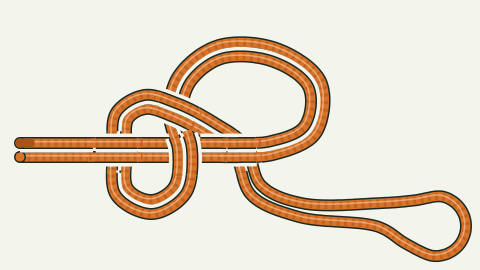
Soft shackle
A loop of strong synthetic braid that closes around a knot at its own end, used in place of a metal shackle.
Loops
Figure-eight loop
A figure-eight tied in a doubled rope to make a strong, easy-to-inspect fixed loop for clipping a carabiner or hook.
Loops
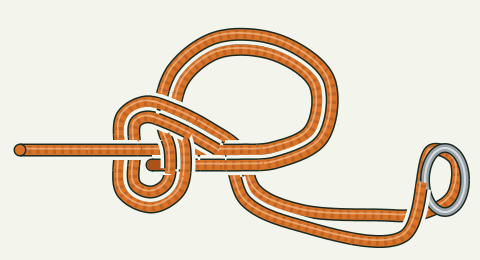
Figure-eight follow-through
A figure-eight loop tied around a closed point, such as a harness or ring, by tying a figure-eight and then retracing it with the end.
Loops
Alpine butterfly
A fixed loop tied in the middle of a rope that can take load from either end of the rope or from the loop itself.
Sources
- NSW Government, Dogging and Rigging Guide: Construction of fibre rope
- Sterling Rope, Utility rope constructions
- Rope, Wikipedia
- Hawser, Wikipedia
- Kernmantle rope, Wikipedia
- Dynamic rope, Wikipedia
- Edelrid: 160 years of Edelrid (1953 first kernmantle rope)
- Rope splicing, Wikipedia
- Eye splice, Wikipedia
- Practical Sailor: Going soft on shackles
- A. Hyatt Verrill, Knots, Splices and Rope Work (public domain, Project Gutenberg)