Rope anatomy: the words for the parts
Every knot instruction uses the same small vocabulary. Learn the dozen words for the parts of a rope and the shapes you make with it, and every guide in this library becomes easy to follow.
Why the words matter
Knot instructions are a kind of map. They only work if you and the writer agree on the names of the landmarks. Sailors, climbers, arborists and riggers all use much the same terms, so learning them once pays off everywhere.
The words below describe two things: the parts of a rope (which end is which) and the shapes you make with it (bights, loops and turns). Almost every knot is a sequence of those shapes, finished by tightening.
The parts of a rope
Standing part: the long, inactive section of the rope. It usually leads to the load, the anchor or the rest of the coil. In most knots you leave it alone and work around it.
Working end: the end you move to tie the knot. Some books call it the running end or the tail once the knot is finished.
Tail: the short length of working end left sticking out of a finished knot. A tail that is too short can pull back through under load. Leave a generous tail, and for climbing or rescue knots follow your training and the equipment maker's instructions on tail length.
Bitter end: the very end of the rope. On a ship it was the end made fast to the bitts, the posts that held the anchor cable.
The shapes you make
Bight: any slack, U-shaped section of rope that does not cross itself. Many knots are tied 'on the bight', meaning you work with a doubled section instead of an end, which lets you tie a loop in the middle of a line.
Loop: a bight whose legs cross, forming a closed circle. Whether the working end crosses over or under the standing part decides which way the loop faces, and that matters in knots such as the bowline and clove hitch.
Turn: one pass of the rope around an object such as a rail, post, ring or another rope. A single turn wraps less than the full circumference.
Round turn: the rope goes fully around the object and continues, so it touches the object on all sides. A round turn gives much more friction than a single turn, which is why the round turn and two half hitches can be held with one hand while you finish it.
Elbow: two crossings made close together by adding an extra twist to a loop. Elbows show up inside more complex knots and in descriptions of how a knot capsizes.
Nip: the point where one part of a rope is pinched against another, or against the object, by the load. The nip is what holds most hitches. If you can see where the nip is, you can usually see why a knot holds and how it might fail.
Finishing a knot: dressing and setting
Dressing: arranging the parts of a knot neatly before tightening, so strands lie side by side without unwanted crossings. A well dressed figure-eight loop looks like two parallel figure eights. Dressing matters because a messy knot can be weaker, harder to inspect and more likely to slip or jam.
Setting: tightening a dressed knot by pulling every strand, not just the standing part, so all the curves bed down evenly. A knot that is dressed but not set can deform or capsize the first time it takes load.
Capsizing: when a knot changes shape under load into a different, often weaker, structure. The reef knot used to join two ropes is a well known example: pull one end the wrong way and it turns into two slipping half hitches.
Handy companion terms
Slipped: a knot finished with a bight instead of the end, so one pull on the tail releases it. Bows on shoelaces are slipped reef knots.
Lay: the direction strands twist in a laid rope. Most three-strand rope is right-hand laid (Z lay).
Whipping: a binding of thin twine around a rope end to stop it fraying. See the guide to finishing rope ends.
For a longer list, see the Strekka glossary.
- Before you tie: find the standing part and the working end.
- While you tie: name each shape as you make it (bight, loop, turn).
- After you tie: dress, set, then check the tail length and where the nip sits.
Knots in this guide
Stoppers
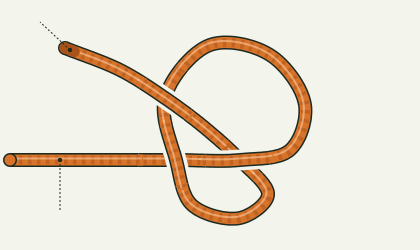
Overhand knot
The simplest knot there is: one loop with the end tucked through, used as a quick stopper and as the starting point for dozens of other knots.
Stoppers
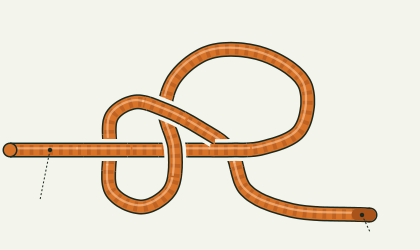
Figure-eight knot
A bulky, easy-to-check stopper that keeps a rope end from running out through a block, cleat, eyelet or device.
Loops
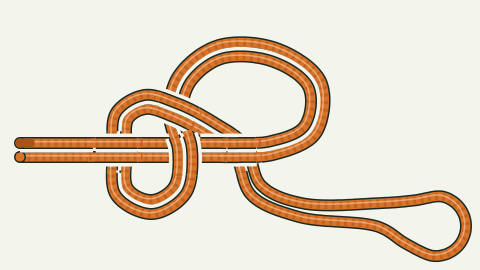
Figure-eight loop
A figure-eight tied in a doubled rope to make a strong, easy-to-inspect fixed loop for clipping a carabiner or hook.
Loops
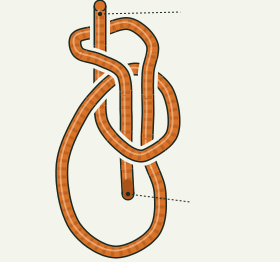
Bowline
A fixed loop in the end of a rope that holds well under steady load and still unties easily afterwards.
Hitches
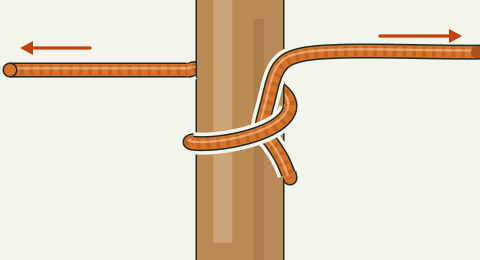
Clove hitch
Two half hitches made in the same direction around a pole, rail or ring: fast to tie and easy to adjust, but not secure on its own.
Hitches
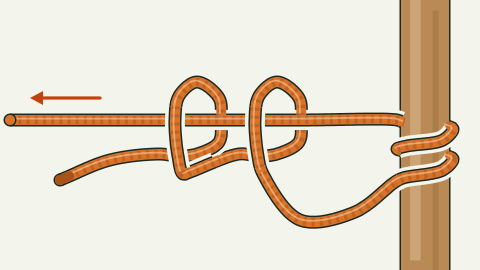
Round turn and two half hitches
A full round turn around a post or ring, finished with two half hitches on the standing part: the dependable everyday way to tie a line off.
Bends
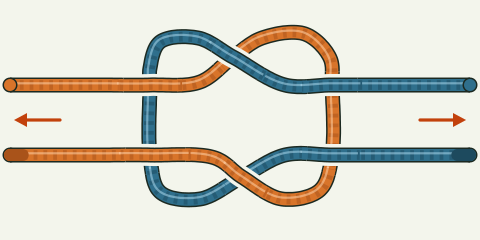
Reef knot
A flat binding knot made of two opposite half knots, for tying the two ends of one cord around a bundle, bandage or sail. It is not a safe way to join two ropes.
Splices & whippings
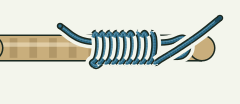
Common whipping
Tight turns of twine wrapped over a loop laid along the rope, with the end drawn back under the turns, to stop a rope end fraying.