Knot families: what each kind does
Knots sort into a handful of families by job. Know the family and you know what the knot is for, what it attaches to and how it tends to fail.
Sort by job, not by look
There are thousands of named knots, but most of them do one of about nine jobs. The Ashley Book of Knots (1944) groups its 3,900 or so entries largely by use, and knot books ever since have followed the same idea. Pick the family first, then pick the knot within it.
A good first question is: what is the rope attached to? Nothing (a stopper), itself (a loop), another rope (a bend), an object (a hitch), or a tensioned line (a friction hitch). The remaining families bind, lash, splice or finish.
Stoppers
A stopper is a knob tied in a rope to stop it running out through a hole, block, grommet or a hand. Stoppers also stop a cut end fraying for a while.
Choose by bulk and ease of untying. The overhand knot is the smallest and jams hardest. The figure-eight knot is a little bulkier and much easier to untie, which is why sailors favour it at the end of sheets. The double overhand stopper is bulkier again and is used as a backup knot.
Loops
A loop knot makes a fixed eye that does not shrink under load. You use it to drop over a post, clip into, or pass a line through.
The bowline is quick and unties easily after load, but it can loosen when not loaded and is not a life-safety knot without proper backing and training. The figure-eight loop and figure-eight follow-through are bulkier, easy to inspect and widely taught in climbing and rescue. The alpine butterfly makes a loop in the middle of a line that can be loaded in three directions.
Bends
A bend joins two rope ends. The right bend depends on whether the ropes match in size and material.
The sheet bend and double sheet bend join ropes of different diameters. The zeppelin bend is secure and unties easily after load. The double fisherman's bend is compact and very secure but jams. The reef knot is a binding knot, not a bend: used to join two ropes that take load, it can capsize and slip, and it has caused accidents.
Hitches
A hitch ties a rope to an object: a post, rail, ring, tree or another rope. Hitches rely on the object to hold their shape, so most fall apart once the object is removed.
The clove hitch is fast and adjustable but can roll off the end of a post under changing load. The round turn and two half hitches holds a steady load well and can be tied while the line is under tension. The timber hitch grips logs for dragging. The trucker's hitch combines a loop and a hitch to make a simple purchase for tensioning.
Friction hitches
A friction hitch grips another rope (or a pole) by wrapping around it. It slides when you push it by hand and locks when loaded. This makes it adjustable.
Campers use the taut-line hitch, midshipman's hitch and adjustable grip hitch on guy lines. Climbers and arborists use the prusik, klemheist, autoblock and Blake's hitch. Grip depends heavily on the two rope diameters and materials, so test a friction hitch on the exact cords you will use. Life-safety uses need training and certified equipment.
Binding knots
A binding knot holds something together: the neck of a sack, a bundle of sticks, a rope end before cutting. The constrictor knot and strangle knot grip so hard they often have to be cut off. The reef knot is a good binding knot over a bundle or a bandage, which is its proper job.
Lashings
A lashing joins poles or spars with many turns of cord, finished with frapping turns and hitches. Square lashings join poles at right angles, diagonal lashings pull crossing poles together, shear lashings make A-frames, and tripod lashings join three legs. Lashings built Pacific canoes, scaffolds and rafts long before bolts were cheap, and they are still used in Hong Kong's bamboo scaffolding (now usually with nylon strips).
Splices
A splice weaves the strands of a rope back into itself or into another rope instead of tying a knot. Splices are neater and generally keep more of the rope's strength than knots, but they are permanent and need the right technique for each rope construction. The eye splice makes a fixed eye, the short splice joins two ropes, the back splice finishes an end, and the locked Brummel eye suits hollow braided rope such as many HMPE lines.
Whippings and finishes
A whipping binds the end of a rope with thin twine to stop fraying. The common whipping is quick. The sailmaker's whipping follows the lay of three-strand rope and stays on better. See the guide to finishing rope ends for the full set of options.
How to pick
Ask four questions in order. What does it attach to? Must it adjust under load? Must it untie easily after a heavy load? What happens if it fails? The last question decides how much margin, backup and training you need.
- Stop a line running out: stopper (figure-eight-knot).
- Fixed eye at the end: loop (bowline, figure-eight-loop).
- Loop in the middle: alpine-butterfly.
- Join two lines: bend (sheet-bend for unequal sizes, zeppelin-bend for equal).
- Tie to a post or ring: hitch (round-turn-two-half-hitches, clove-hitch).
- Adjustable guy line: friction hitch (midshipmans-hitch, taut-line-hitch).
- Clamp a bundle shut: binding knot (constrictor-knot).
- Join poles: lashing (square-lashing, shear-lashing).
- Permanent eye or joint: splice (eye-splice).
Knots in this guide
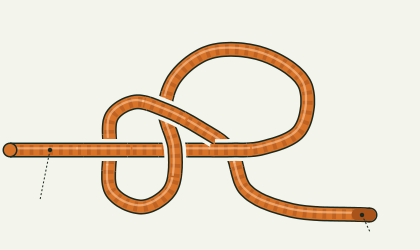
Stoppers
Figure-eight knot
A bulky, easy-to-check stopper that keeps a rope end from running out through a block, cleat, eyelet or device.
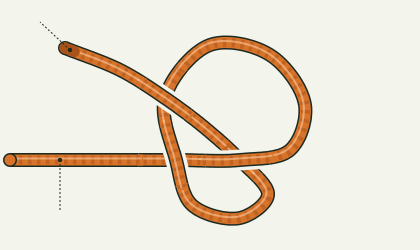
Stoppers
Overhand knot
The simplest knot there is: one loop with the end tucked through, used as a quick stopper and as the starting point for dozens of other knots.
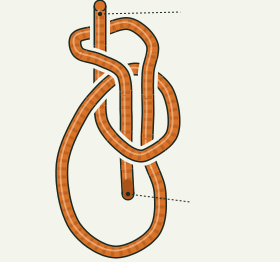
Loops
Bowline
A fixed loop in the end of a rope that holds well under steady load and still unties easily afterwards.
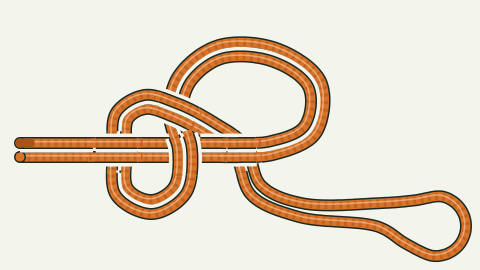
Loops
Figure-eight loop
A figure-eight tied in a doubled rope to make a strong, easy-to-inspect fixed loop for clipping a carabiner or hook.
Loops
Alpine butterfly
A fixed loop tied in the middle of a rope that can take load from either end of the rope or from the loop itself.
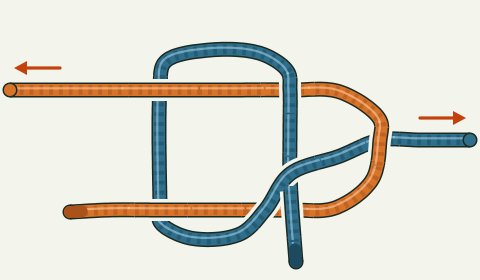
Bends
Sheet bend
The everyday knot for joining two ropes, and the best simple bend for ropes of different thickness.
Bends
Zeppelin bend
A secure, symmetrical join of two interlocked overhand loops that resists jamming and unties easily after heavy load.
Bends
Double fisherman's bend
Two double overhand knots, each tied around the other rope, that slide together into a very strong, near-permanent join.
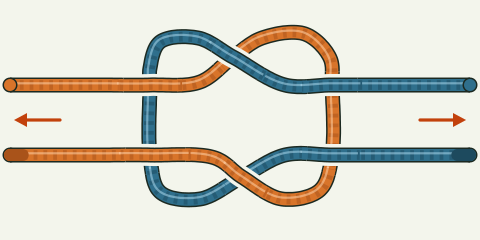
Bends
Reef knot
A flat binding knot made of two opposite half knots, for tying the two ends of one cord around a bundle, bandage or sail. It is not a safe way to join two ropes.
Sources
- Ashley Book of Knots, Wikipedia
- List of knots, Wikipedia
- Stopper knot, Wikipedia
- Bend (knot), Wikipedia
- Hitch (knot), Wikipedia
- Friction hitch, Wikipedia
- Binding knot, Wikipedia
- Lashing (ropework), Wikipedia
- Reef knot, Wikipedia
- Rope splicing, Wikipedia
- Hong Kong Free Press: Hong Kong's bamboo scaffolders preserve ancient technique (2023)
- A. Hyatt Verrill, Knots, Splices and Rope Work (public domain, Project Gutenberg)