Rope glossary
Plain definitions for more than a hundred words used by sailors, climbers, riggers, tentmakers and knot tyers, from ABOK to Z lay.
A
ABOK: short for The Ashley Book of Knots (1944) by Clifford Ashley. Its numbered entries are used as reference numbers for knots, for example ABOK 1245.
Abseil: to descend a rope in a controlled way using a friction device. Called rappelling in North America. Requires training and certified equipment.
Accessory cord: small-diameter kernmantle cord, usually 2 to 8 mm, used for guy lines, prusik loops and general utility.
Aglet: a hard tip on the end of a cord or lace that makes it easy to thread.
Alpine coil: a round coil finished by wrapping the tail around the top. Also called a mountaineer's coil.
Anchor: any fixed point a rope is tied to, such as a stake, tree, rail or bolt.
Aramid: a family of very strong, low-stretch, heat-resistant synthetic fibres, including Kevlar, Technora and Twaron.
B
Back splice: a finish for three-strand rope where the strands are crowned and tucked back down the rope.
Baggywrinkle: shaggy padding made from old rope yarns, wrapped around rigging to stop sails chafing.
Becket: a small loop or eye in a rope, or the eye on a block, used to attach a line or toggle.
Belay: to make a line fast around a cleat or pin. In climbing, to manage the rope for a climber to protect them in a fall.
Bend: a knot that joins two rope ends.
Bight: a slack, U-shaped section of rope that does not cross itself.
Bitter end: the very end of a rope.
Block: a pulley in a case, used in tackles.
Boltrope: a rope sewn along the edge of a sail or awning to strengthen it and spread load.
Braid: rope made by interlacing strands, as opposed to twisting them.
Breaking strength: the load at which a rope breaks in a standard test.
C
Cable-laid: three ropes twisted together into a larger rope, the way strands are laid into a rope.
Capsize: when a knot changes shape under load into a different and often weaker structure.
Catenary: the curve a flexible line takes when it hangs under its own weight.
Chafe: wear from rubbing against an edge or surface.
Cleat: a fitting with horns or jaws that holds a line.
Coil: rope gathered into loops or folds for storage or carrying.
Cordage: a general word for rope, cord, twine and string.
Core: the inner, usually load-bearing, part of a sheathed rope.
Creep: slow, permanent stretch under a sustained load. HMPE is prone to it.
Cringle: a reinforced eye worked into the edge rope of a sail or awning.
Crown knot: a knot that interweaves the strands at the end of a rope, the start of a back splice.
D
Deadeye: a round wooden block with holes, laced with a lanyard to tension the shrouds of traditional ships.
Design factor: the number a breaking strength is divided by to set a working load limit. Also called a safety factor.
Double braid: a braided core inside a braided cover. Also called braid on braid.
Dressing: arranging the parts of a knot neatly before tightening.
Dynamic rope: rope designed to stretch and absorb the energy of a fall, used for lead climbing.
Dyneema: a brand name for UHMWPE (HMPE) fibre.
E
Elbow: two crossings made close together by adding a twist to a loop.
Euphroe: a long wooden slat with a row of holes that gathers a fan of light lines to one point, traditionally used to hold up ships' awnings.
Eye: a permanent loop at the end of a rope, made by a splice, a knot or stitching.
Eye splice: a splice that forms a permanent eye by tucking the strands back into the rope.
F
Fall factor: in climbing, the length of a fall divided by the length of rope available to absorb it. Higher numbers mean harsher loads.
Fid: a tapered tool, often hollow, used to open strands or carry them through braided rope when splicing.
Flaking: laying a rope down in loose loops or figure-eight folds so it runs out freely.
Frapping turns: turns taken around a lashing between the poles to tighten it.
Friction hitch: a hitch that grips another rope or a pole by friction and can slide when not loaded.
G
Gasket: a short line used to tie a furled sail to its spar.
Grommet: a ring laid up from a single strand of rope. Also used for a metal eyelet in fabric.
Guy line: a line that steadies a pole, mast or tent against sideways forces.
H
Halyard: a line used to raise a sail, flag or yard.
Hank: a small bundle of cord wound in figure-eight turns and tied around the middle.
Hawser: a large rope used for mooring or towing.
Heaving line: a light line thrown from a ship to the shore or a tug, used to pull across a heavier mooring line.
Hitch: a knot that ties a rope to an object or to another rope under load.
HMPE: high-modulus polyethylene, another name for UHMWPE fibre.
Hockle: a twisted kink in laid rope caused by twisting it against its lay or releasing load suddenly.
K
Kernmantle: rope built from a load-bearing core (kern) inside a braided sheath (mantel). German for core and sheath.
Kink: a sharp twist or bend in a rope that can weaken it.
Knot efficiency: the strength of a knotted rope as a percentage of the unknotted rope's strength.
L
Laid rope: rope made by twisting strands together, as opposed to braiding.
Lanyard: a short line used to secure or tension something, such as the line laced through deadeyes.
Lashing: a binding of many turns used to join poles or secure objects.
Lay: the direction and tightness of the twist in a laid rope.
Lead: the direction a line runs. A fairlead is a fitting that guides it.
M
Marline: thin, tarred two-strand twine used for seizing and serving.
Marlinspike: a pointed metal spike used to open strands for splicing and as a lever for tightening.
Mechanical advantage: the ratio of output force to input force in a purchase or lever.
Minimum breaking strength: the lowest load at which a new rope of a given type is expected to break in a standard test.
Monkey's fist: a ball-shaped knot tied at the end of a heaving line to give it weight for throwing.
N
Nip: the point where a rope is pinched by another part of itself or by the object, holding a hitch in place.
Nylon: a stretchy, strong synthetic fibre (polyamide), good at absorbing shock.
O
Overhand knot: the simplest knot, a single loop with the end passed through.
On the bight: tied using a doubled section of rope instead of an end.
P
Parcelling: wrapping strips of cloth around a rope before serving it, to keep water out.
Parrel: a collar of beads or a loop of line that holds a spar to a mast while letting it slide.
Plaited rope: rope made of strands plaited in pairs, such as eight-strand square braid.
Polyester: a strong, low-stretch, UV-resistant synthetic fibre, the default for lines that must stay tight.
Polypropylene: a cheap, light synthetic fibre that floats but degrades in sunlight and melts at a low temperature.
Purchase: any arrangement of rope, pulleys or levers that multiplies pulling force.
R
Ratline: a rope rung tied across a ship's shrouds to make a ladder.
Reef point: a short cord through a sail used to tie up a reduced (reefed) sail.
Ridgeline: a line strung between two points to support a tarp or shelter.
Ropewalk: a long building or alley where rope was made by walking the strands apart as they twisted.
Round turn: a complete wrap of rope around an object.
Running rigging: the lines that move, such as halyards and sheets, used to raise and trim sails.
S
S lay: a left-hand twist in yarn or rope. See Z lay.
Seizing: a binding of small line that holds two ropes, or two parts of one rope, together.
Sennit: braided cordage. In the Pacific, the word often refers to cord braided from coconut husk fibre.
Serving: a tight binding of small line wrapped around a rope against the lay to protect it.
Setting: pulling every strand of a dressed knot to tighten it evenly.
Sheave: the grooved wheel inside a block or pulley.
Sheet: a line used to control the angle of a sail. Not the sail itself.
Shock load: a sudden load, such as a drop or jerk, that produces a peak force far above the static weight.
Slipped: a knot finished with a bight so it can be released with one pull.
Splice: a join or eye made by interweaving rope strands rather than tying a knot.
Standing part: the inactive part of the rope, leading away from the knot.
Standing rigging: the fixed lines, such as shrouds and stays, that hold a mast up.
Static rope: low-stretch rope used for abseiling, hauling and rope access.
Stopper: a knot that makes a knob to stop a rope running out.
Strand: one of the twisted bundles of yarn that make up a laid rope.
T
Tackle: a set of blocks and rope used as a purchase. Pronounced 'tay-kel' by many sailors.
Tail: the short end left protruding from a finished knot.
Taut: pulled tight with no slack.
Thimble: a grooved metal or plastic insert in an eye that protects the rope from wear and tight bends.
Toggle: a short bar or wooden peg passed through a loop (a becket) to make a quick-release fastening.
Turk's head: a decorative woven knot that forms a ring around a rope, rail or handle.
Turn: one pass of a rope around an object.
U
UHMWPE: ultra-high-molecular-weight polyethylene, an extremely strong, light, low-stretch fibre sold as Dyneema and Spectra.
UV degradation: damage to fibres from sunlight, which makes rope stiff, faded and weak over time.
W
Webbing: flat or tubular woven strip used for slings, straps and harnesses.
Whipping: a binding of thin twine around a rope end to stop it fraying.
Working end: the end of the rope you move to tie a knot.
Working load limit: the maximum load a rope or fitting should carry in normal service, equal to breaking strength divided by a design factor.
Worming: laying small line into the grooves between the strands of a rope to make it round before parcelling and serving.
Y
Yarn: fibres twisted together. Yarns are twisted into strands, and strands into rope.
Z
Z lay: a right-hand twist in yarn or rope, so called because the strands slope like the middle stroke of the letter Z. Most three-strand rope is Z laid.
Knots in this guide
Stoppers
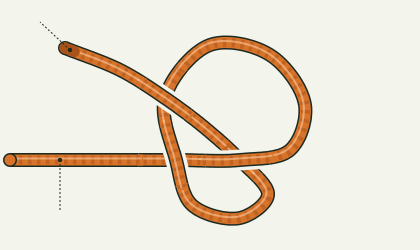
Overhand knot
The simplest knot there is: one loop with the end tucked through, used as a quick stopper and as the starting point for dozens of other knots.
Splices & whippings
Back splice
A way of finishing a rope's end by forming a crown knot with its strands and tucking them back down the rope, so it cannot fray.
Splices & whippings
Eye splice
A permanent loop made by weaving the strands of a rope's end back into its own standing part.
Functional & decorative
Monkey's fist
A round ball of woven cord tied in the end of a line to give it weight for throwing, or as a knob or ornament.
Functional & decorative
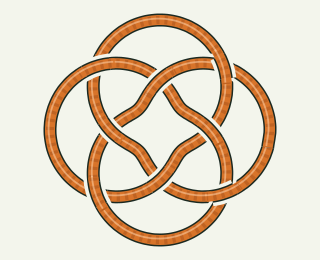
Turk's head
A woven ring of cord tied around a cylinder, used as a collar, grip, marker or ornament.
Functional & decorative
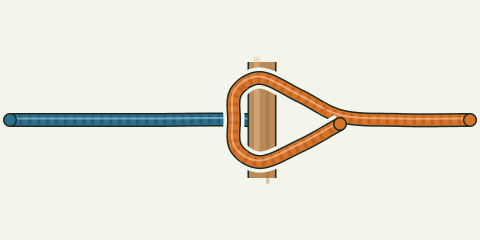
Toggle and becket
A short pin on one part that pushes through a rope loop on the other, giving a strong connection that opens instantly.
Tensioners
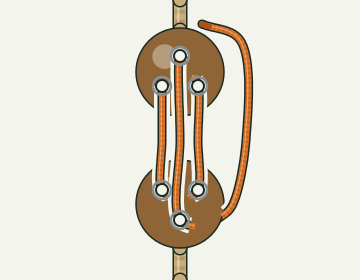
Deadeye and lanyard
A pair of holed wooden discs laced together with a lanyard, used to set up and tension a ship's shrouds.
Functional & decorative
Rope grommet
A seamless ring laid up from a single strand of three-strand rope, with no splice and no metal.
Functional & decorative
Reef point
A short cord fixed through a sail or panel, used to tie up the loose cloth when the sail is reduced, usually with a slipped reef knot.
Sources
- Glossary of nautical terms (A to L), Wikipedia
- Glossary of nautical terms (M to Z), Wikipedia
- Ashley Book of Knots, Wikipedia
- Rope, Wikipedia
- Kernmantle rope, Wikipedia
- Worm, parcel and serve, Wikipedia
- Deadeye, Wikipedia
- Euphroe, Wiktionary
- Ratline, Wikipedia
- Cringle, Wikipedia
- Parrel, Wikipedia
- Sennit, Wikipedia
- Ropewalk, Wikipedia
- Monkey's fist, Wikipedia
- Working load limit, Wikipedia
- A. Hyatt Verrill, Knots, Splices and Rope Work (public domain, Project Gutenberg)