Finishing rope ends
A cut rope starts to unravel straight away. Whipping, heat-sealing, tape, a back splice or an end cap all stop it. This guide explains each method and which ropes it suits.
Why finish an end
An unfinished end frays, grows fat and will not pass through a grommet, block or cleat. Frayed rope also loses length every time you trim it. A good finish keeps the rope its full diameter right to the end and makes it easy to thread.
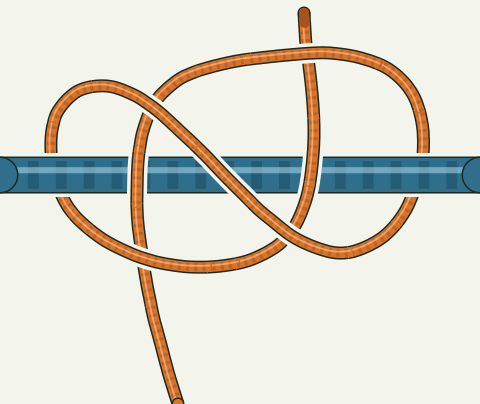
Always secure the rope before you cut it. A tight constrictor knot or a few wraps of tape either side of the cut keeps the strands together while you work.
Whipping
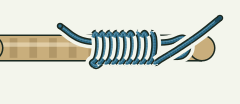
A whipping is a tight binding of thin twine (whipping twine or waxed thread) around the end of a rope. It works on every fibre and every construction, and on natural fibre it is the only reliable finish. Old seamanship manuals, including Verrill's 1917 Knots, Splices and Rope Work, describe several whippings, and they are still the mark of a well kept rope.
Common whipping: twine laid along the rope and wrapped over itself, with the end pulled back under the turns. Quick, no tools, good for most cords. It can slide off a slippery rope if it is not tight.
Sailmaker's whipping: the twine follows the lay of three-strand rope in frapping turns along the grooves, locking the whipping in place. It is the most secure whipping for laid rope.
Sewn or palm-and-needle whipping: stitched through the rope as well as around it. The most durable whipping for braided and double-braided rope, often used on sheets and halyards.
Length guide: a whipping about as long as the rope is wide, or a little longer, is a common target. On large rope, two short whippings a little apart hold better than one long one.
Heat-sealing (melting)
Most synthetic ropes (nylon, polyester, polypropylene) can be fused at the end with a flame or, better, a hot knife. Cutting with a hot knife cuts and seals in one step and leaves a neat end.
Melting alone leaves a hard, sometimes sharp bead that can crack off over time, especially on larger rope. A whipping over a sealed end is the professional finish.
It does not work on natural fibres, which burn rather than melt, and it works poorly on HMPE, which melts at a low temperature and does not fuse well, or on aramid, which does not melt. Work outdoors or with good airflow, keep molten plastic off skin, and never melt rope near the flammable fabrics of a tent.
Tape
Electrical tape or rigging tape wrapped tightly around the end is a quick, temporary finish. It is useful while you are working on a rope and for marking a cut line, but it peels off with use and in sun. Replace it with a whipping when you can.
Back splice
In three-strand rope, the strands can be unlaid, crowned (tucked over each other at the end) and then tucked back down the rope against the lay. The result is a permanent end that is a little thicker than the rope. It will not pass through tight blocks, but it never comes undone and needs no twine. It suits mooring lines, bell ropes and the ends of three-strand lines on traditional rigs.
End caps, dips and stoppers
Shrink tube and plastic end caps, sold for shoelace-style aglets, give a neat, hard tip for threading cord through eyelets and lacing. Liquid rope-end dips coat the end in a rubbery layer.
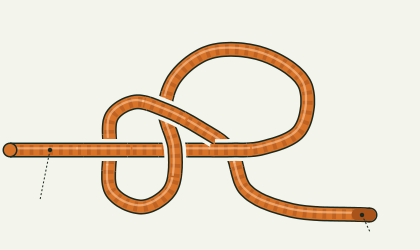
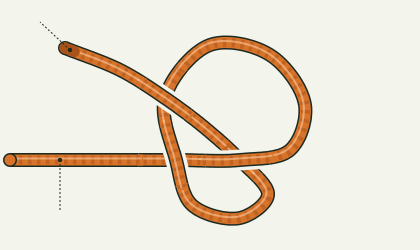
A stopper knot such as a figure eight or an overhand will also stop an end fraying for a while, and it stops the line running out. It is a stopgap, not a finish.
Which finish for which rope
For a shelter web, a simple rule works: ends that thread through eyelets and lacing get a firm, sealed tip, and ends that take load are finished with a splice or a whipping.
- Natural fibre: whipping (sailmaker's on three-strand), or back splice.
- Polyester or nylon three-strand: heat-seal, then sailmaker's whipping; or back splice.
- Braided or double-braid polyester: hot-knife cut, then sewn whipping.
- Kernmantle accessory cord: hot-knife cut; a short whipping or shrink tube on cord that is often threaded.
- HMPE: whipping or a sewn finish, or taper and bury the end; do not rely on melting.
- Polypropylene: heat-seal works well; add tape or a whipping for heavy use.
Knots in this guide
Splices & whippings
Common whipping
Tight turns of twine wrapped over a loop laid along the rope, with the end drawn back under the turns, to stop a rope end fraying.
Splices & whippings
Sailmaker's whipping
A very durable whipping for laid rope in which the twine is also laid along the grooves between the strands, so the turns cannot slide off.
Splices & whippings
Back splice
A way of finishing a rope's end by forming a crown knot with its strands and tucking them back down the rope, so it cannot fray.
Binding knots
Constrictor knot
A binding knot like a clove hitch with the end tucked to form an overhand knot under a riding turn; it bites down hard and stays put.
Stoppers
Figure-eight knot
A bulky, easy-to-check stopper that keeps a rope end from running out through a block, cleat, eyelet or device.
Stoppers
Overhand knot
The simplest knot there is: one loop with the end tucked through, used as a quick stopper and as the starting point for dozens of other knots.
Splices & whippings
Eye splice
A permanent loop made by weaving the strands of a rope's end back into its own standing part.