Coiling, storage and rope care
A rope that is coiled well comes off without tangles and lasts longer. This guide covers the butterfly and alpine coils, flaking, hanking small cord, and how to wash, dry and store rope.
Why coil carefully
Most tangles are put into a rope when it is stored, not when it is used. A good coil keeps the rope free of twists, makes it easy to carry, and lets it run out cleanly when you need it in a hurry. Twisted rope also kinks and, in three-strand rope, forms hockles that weaken it.
Butterfly coil
Also called the backpacker's coil. The rope is laid back and forth across your hand or shoulders in long folds instead of round loops, so it puts no twist into the rope. Petzl notes it is easy to learn and reduces twists. The finished coil is bound with a few wraps and can be worn like a backpack using the two tails.
Best for kernmantle and braided rope, and for any rope that has to run out quickly without kinks. Long, loose folds can snag on branches when carried through scrub.
Alpine coil (mountaineer's coil)
A traditional round coil, with each loop laid in turn, finished by wrapping the tail around the top of the coil and passing a bight through. It is neat and compact, but because it forms round loops it puts a twist into the rope with each loop and is more prone to tangles when uncoiled. Lay three-strand rope clockwise (with the lay) and it coils naturally.
Figure-eight flaking and laying down rope
Flaking means laying rope on the ground or deck in a loose pile or in figure-eight folds so it can run out freely. A figure-eight pattern lets each loop cancel the twist of the one before. Sailors flake anchor rodes and mooring lines this way so they pay out without snarling. Climbers flake a rope into a loose pile before a climb to find tangles early.
Hanking small cord
Thin cord such as guy lines and lacing cord is best stored in small hanks. Wind it in figure-eight turns around your thumb and little finger (or around a short stick or a cord winder), then finish with a few wraps around the middle and a half hitch or slipped loop. Figure-eight winding avoids twist, and a hank shakes out quickly. Pre-hanked guy lines are one reason a tent goes up fast.
Washing
Wash rope only when it needs it: when it is gritty, sandy, salty or muddy. Grit works into the fibres and cuts them from the inside.
Petzl's guidance for climbing rope: inspect it first, wash with clean water and a mild soap rather than laundry detergent, never use solvents, degreasers or high-pressure sprayers, and air-dry away from sun and heat. Rinse well. Rope can shrink a little when washed, so check the length and markings afterwards.
Salt water rope should be rinsed in fresh water; dried salt crystals are abrasive and hold moisture.
Drying and storage
Sunlight, chemicals and grit do more damage to rope in storage than most people realise. A clean rope bag is cheap protection.
- Dry in loose coils or loops in the shade, away from direct sun and heat sources.
- Never dry rope on a heater or in a clothes dryer.
- Make sure natural-fibre rope is fully dry before storing, or it will rot and mildew.
- Store loosely coiled or hanked, off concrete floors, in a cool, dry, dark place.
- Keep rope away from fuel, battery acid, solvents and car boots where chemicals are carried.
- Do not store rope under tension; let guy lines and ridgelines relax when packed away.
- Label hanks and coils with length, diameter and date of purchase.
Knots in this guide
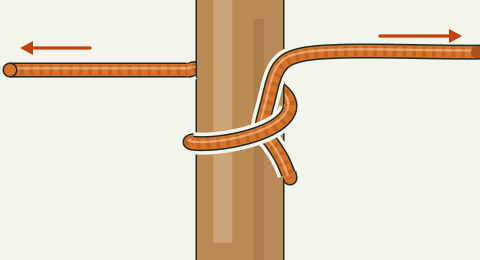
Hitches
Clove hitch
Two half hitches made in the same direction around a pole, rail or ring: fast to tie and easy to adjust, but not secure on its own.
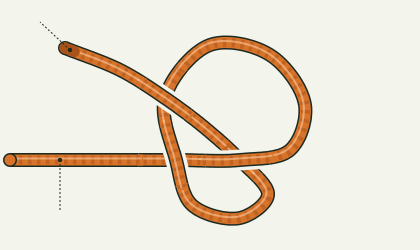
Stoppers
Overhand knot
The simplest knot there is: one loop with the end tucked through, used as a quick stopper and as the starting point for dozens of other knots.
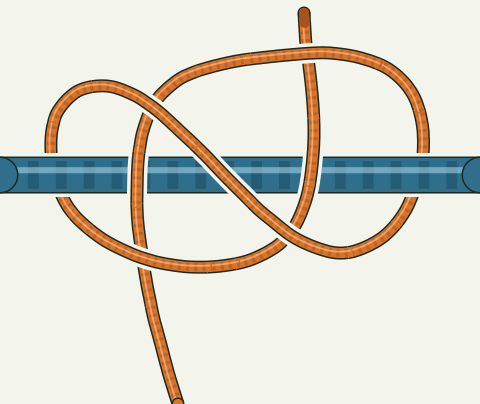
Binding knots
Constrictor knot
A binding knot like a clove hitch with the end tucked to form an overhand knot under a riding turn; it bites down hard and stays put.
Functional & decorative
Chain sinnet
A row of crochet-like loops, each pulled through the last, that shortens and stores a rope and runs out instantly when released.