Choosing the right knot
A job-first guide. Find the task you are doing, then pick from a short list of knots that suit it, with the trade-offs that decide between them.
How to use this guide
Start from the job, not the knot. Each section below names a common task, gives a first choice and one or two alternatives, and says when to switch. Every knot named links to its own page in the library.
If a person's safety depends on the rope, stop here: get training and use certified equipment. Nothing in this guide is a substitute.
Stop a rope running out
First choice: figure-eight knot. Bulkier than an overhand and much easier to untie after load.
Alternatives: overhand knot when you want the smallest possible knob and do not need to untie it; double overhand stopper when a hole is too big for a figure eight or you want a backup knot behind a loop.
Make a fixed loop at the end
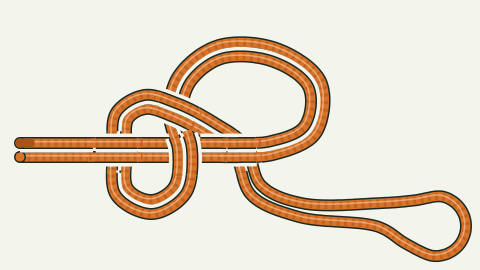
First choice for general use: bowline. Quick to tie, easy to untie after heavy load. It can work loose when it is not under load, so do not use it unattended on a line that flogs, and never as a life-safety knot without training and proper backing.
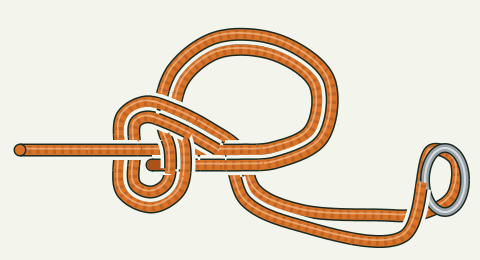
First choice when security and easy inspection matter: figure-eight loop, or the figure-eight follow-through when you need to tie around a ring or post. Harder to untie after heavy load.
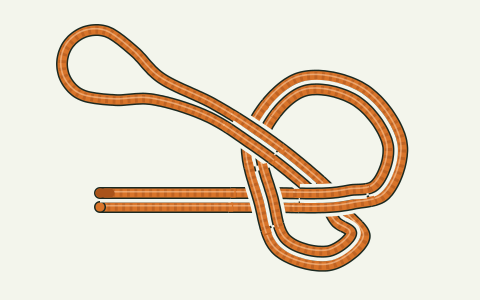
Alternatives: bowline on a bight for a doubled loop; overhand loop for a quick, small, permanent loop in cord.
Make a loop in the middle of a line
First choice: alpine butterfly. It takes load in three directions and unties well. Use it for a mid-line attachment point, to isolate a damaged section, or as the loop in a trucker's hitch on a heavily loaded line.
Join two ropes
Different sizes or stiffness: sheet bend; double sheet bend when the difference is large or the rope is slippery.
Same size, must untie after load: zeppelin bend. Figure-eight bend is a well known alternative that is easy to check.
Permanent, very secure, cord loops: double fisherman's bend (it jams, which is the point).
Flat webbing or tape: water knot, with long tails, checked often.
Avoid: reef knot as a bend. It can capsize and slip under load.
Tie to a post, rail, ring or tree
Holding a steady load: round turn and two half hitches. You can hold the load on the round turn while you finish.
Quick, adjustable, light load: clove hitch. Add half hitches if the load changes direction, because it can roll.
Hanging gear or fixing to a ring that will be loaded hard and may need releasing: buntline hitch (jams more) or anchor bend (for rings and anchors).
Dragging logs or lifting poles: timber hitch, with a half hitch further along to keep the log in line.
Mooring to a post or pile: pile hitch (on a bight, very fast) or round turn and two half hitches.
Tension a guy line or ridgeline
Adjustable guy lines: midshipman's hitch, taut-line hitch or adjustable grip hitch. Test on your actual cord; thin or slippery cord may need the adjustable grip hitch or an extra wrap.
Pulling a ridgeline or load-binding line tight: trucker's hitch. Finish with two half hitches or a slipped hitch.
No-knot tensioning alternatives: versatackle (a self-locking purchase from cord alone), Spanish windlass (twist with a stick) and deadeye lanyard.
Grip another rope or a pole
On a rope, loaded along the rope: prusik (symmetrical, works both ways), klemheist (one direction, works with tape), autoblock (backup on a descent, used by trained people), Blake's hitch (arborists, trained use).
On a pole or spar, pulled lengthwise: rolling hitch.
All friction hitches depend on the diameters and materials involved. Test before relying on them.
Bind, clamp or close
Clamp a bundle or close a bag hard: constrictor knot (cut it off afterwards) or strangle knot.
Tie a bandage or a parcel flat: reef knot, which is its proper job.
Temporary whipping before cutting rope: constrictor knot, then a proper whipping.
Join poles into frames
Right angles: square lashing. Crossing poles that need pulling together: diagonal lashing. A-frames and sheer legs: shear lashing. Three-legged stands: tripod lashing. Poles side by side: round lashing.
Make something permanent
Fixed eye in three-strand rope: eye splice. Fixed eye in hollow braid or HMPE: locked Brummel eye. Rope-only shackle: soft shackle. Stop an end fraying: sailmaker's whipping or common whipping, or a back splice in three-strand.
Point fastenings that open with a glove on: toggle and becket. Edge-to-edge joins between panels: chain lacing.
- Stop: figure-eight-knot
- End loop: bowline, figure-eight-loop
- Mid-line loop: alpine-butterfly
- Join: sheet-bend, zeppelin-bend, double-fishermans-bend
- Tie off: round-turn-two-half-hitches, clove-hitch
- Tension: midshipmans-hitch, truckers-hitch
- Grip: prusik, rolling-hitch
- Bind: constrictor-knot
- Frame: square-lashing
- Permanent: eye-splice, sailmakers-whipping
Knots in this guide
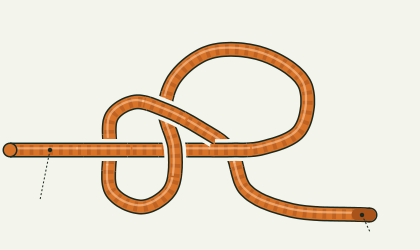
Stoppers
Figure-eight knot
A bulky, easy-to-check stopper that keeps a rope end from running out through a block, cleat, eyelet or device.
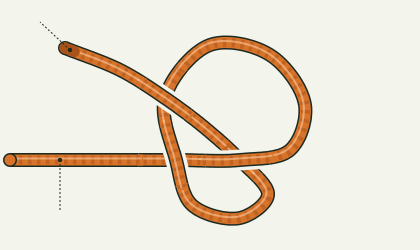
Stoppers
Overhand knot
The simplest knot there is: one loop with the end tucked through, used as a quick stopper and as the starting point for dozens of other knots.
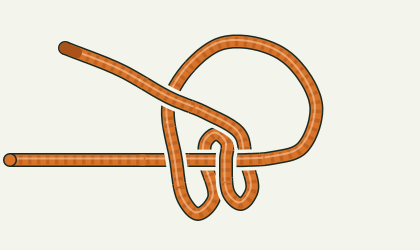
Stoppers
Double overhand stopper
An overhand knot with one extra wrap, giving a fatter, firmer stopper that is hard to pull through anything.
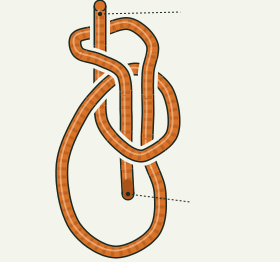
Loops
Bowline
A fixed loop in the end of a rope that holds well under steady load and still unties easily afterwards.
Loops
Figure-eight loop
A figure-eight tied in a doubled rope to make a strong, easy-to-inspect fixed loop for clipping a carabiner or hook.
Loops
Figure-eight follow-through
A figure-eight loop tied around a closed point, such as a harness or ring, by tying a figure-eight and then retracing it with the end.
Loops
Bowline on a bight
A bowline tied in a doubled rope to make two fixed loops in the middle of a line, without needing either end.
Loops
Overhand loop
An overhand knot tied in a doubled rope to make a quick fixed loop anywhere along a line.
Loops
Alpine butterfly
A fixed loop tied in the middle of a rope that can take load from either end of the rope or from the loop itself.